Thursday, December 31, 2009

Workflow


A few years ago when I discovered Google Calendar, Docs, iGoogle, Reader and on and on and on I was really thrilled that I could have all my 'stuff' online and accessible from any internet ready device. I'm not sure that all of those apps have increased my workflow though. Ease of collaboration, yes! Ease of sharing, yes! Ease of access, yes! More work done in less time--well, not really.

Background


I teach at a distributed learning school. I am responsible for Science 8 - 12 courses as well as Math 8 - 11. The math courses are all paper based and the science courses are all online. My students work from home, but they have access to face-to-face tutorials, online tutorials via Elluminate, as well as help as needed via phone, e-mail and face-to-face. The students work asynchronously at their own pace. This means that it is rare that I mark two of the same assignments in a row.

When Technology Makes Life Decidedly Better


Part 1: Moodle


This fall my district undertook to host Moodle on its own server. Prior to this our online course offerings were through WebCT (an oldish version). In our Moodle courses assignments can be submitted electronically within the course, with alerts being sent to the teacher to let them know when new material is ready to be marked.

Part 2: HP Tablet Laptop


Our school has had 2 HP Tablet laptops for the past couple of years. If you haven't seen or used one of these, you have the ability to draw directly on the screen using a special pen. There is handwriting recognition software which can convert handwriting into typed text. Prior to this year I have used the tablets with a projector when teaching to write notes and instructions, just as you might use a felt pen and transparencies on an overhead projector.
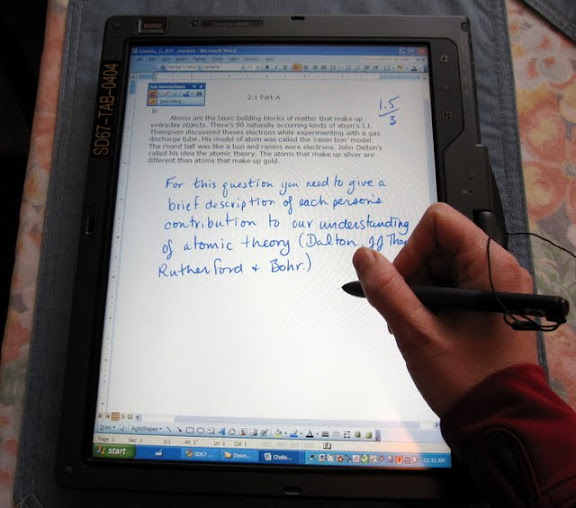
Marking with the HP Tablet

Marking with the HP Tablet

Part 3: Putting It All Together


Here's what happens when you combine Moodle with the HP tablet.

I receive an e-mail alert that a student has submitted an assignment. I click on the link and am taken to the assignment in Moodle. I select the student's file which is downloaded on my computer and opened in word. Using the pen on the tablet I can easily mark and add comments to the assignment (marking with the pen tool is far easier than adding comment boxes). I then save the file with a new name. I go back to Moodle, input the grade, and upload the marked file. The student will now receive an e-mail alert to tell them that their work has been marked. Easy peasy!

Prior to using Moodle, when students e-mailed in their work I had to save it to a specific folder, mark it, go to my marks program to record the mark, save the marked file, attach it to an e-mail and send it to the student. Lots of clicks, lots of little pieces to remember to do.

Prior to using Moodle, most students did their work on paper and dropped it off at the school. There was a delay between the student finishing the work and me receiving it and then a delay between me marking the work and them picking it up. And then there are the (infrequent) times I'd forget to record the mark and the times that students claimed that they handed in their work but it disappeared or they claimed that the marked work never reached them. This doesn't happen with the new system! In addition, it is far more convenient to carry home just a laptop as opposed to envelopes of student work. Students also tended to hand in a whole whack of work all at once, preventing timely feedback. In Moodle students are less likely to do this.

I'm finding it difficult to convey how smooth and seamless the Moodle/tablet combination is! Let me just say that I actually look forward to marking now (sick, I know).

How 'Bout You?


Is there some system or technology that you use that actually helps your workflow to a significant degree? I'd love to hear about it.

Now if you'll excuse me, I'm going to see about getting all of those math courses I teach into Moodle ;-)

Monday, December 21, 2009

Most Influential Post of 2009

Requisite--So I Haven't Blogged For A While...


Lately my on-line participation has shifted more towards Twitter and the relatively new social networking site for BC educators, CEET (Community of Expertise in Educational Technology). Coupled with starting to using Moodle for course delivery and learning more about online course design, I've been less active with my blog.

Edublog Awards


Though I haven't been blogging much, I have watched with interest the Edublog Awards. I never got off my butt to make any nominations--so thank you to all those folks who did. The nomination list is always a good place to find interesting voices that are new to me.

Better Late Than Never... My Nomination


Though I didn't nominate anyone, I would like to highlight this post by Stephen Downes as the post that I found most influential in 2009. The post, titled The Monkeysphere Ideology, refers to a Cracked article from 2007 (yes, that Cracked.) From Downes:
Now let's look at the Cracked article, which suggests that each of us has a limit of about 150 people we can know and understand and relate to. The theory is based on Dunbar's number, and Cracked calls it - with more than a little alacrity - the 'monkeysphere'. The article, which was written in 2005, is making the rounds again.

Sock Monkey Group by sunsetgirl creations
One of the key points that Downes makes is:
Our failure lies not in the fact that we cannot know and understand more than 150 people. That's just a fact of physiology. Rather, our failure lies in how we characterize the remaining 99.99 percent of humanity: as though they were automatons.

I see this 'us and them' mentality pervading so much of life. Now whenever I do I think of the monkeysphere. For example; there has been so much in the news lately to do with global warming, and CBC ran this piece last week on the disputed island of Miningo. Because of global warming the water temperature in Lake Victoria is rising and water levels are dropping. This, along with overfishing, is resulting in increased pressure on the Nile perch stocks in the lake. Miningo island has become the flash point for Ugandan and Kenyan fishers who are finding it increasingly difficult to catch enough fish. From the CBC story:
The change in Lake Victoria is important because some 30 million people rely on it for their livelihood.

It is in situations like this that the monkeysphere ideology comes into play in a powerful way. Take this quote from the CBC story:

Kenyan fisherman Paul Odhiambo sorts through his catch of Nile perch in the bottom of his boat moored along Migingo's rocky shore. His anger rises quickly when thinking of Uganda.


"They just come with tear gas. And spraying us with the tear gas," he says. "So these people are not human. Just look at them. They are carrying guns. Why? Why carrying guns at this small place."


"So these people are not human." Where have you heard this before? Where else has this been justification for treating other human beings like garbage? But this is not a Uganda/Kenya problem. It is a human problem.


Since I read Downes' post, I've been thinking about the monkeysphere quite a bit. I am more aware when those around me and those I hear and read about "characterize the remaining 99.99 percent of humanity: as though they were automatons." or worse...


What About You?


What do you think about the monkeysphere? And what blog post, book , article, etc has influenced you in a big way this year? Thanks as always for reading, and I welcome comments. Cheers!

Saturday, October 3, 2009

Re-visiting the PD 2009 Meme

Early in the summer I was tagged for the Professional Development Meme 2009. This meme was started by Clif Mims. Normally I'm not crazy about memes--they remind me too much of chain letters--but I felt that this one was worth my time :-) For the meme I wrote a post about three goals I would like to accomplish over the summer. Below I'll list the goals and how I did.

  • Read 'Disrupting Class: How Disruptive Innovation Will Change the Way the World Learns'. Not only did I read the book, I blogged my reflections on it here.

  • Learn more about teaching using Moodle. I chose this as a goal because my district was moving over to using Moodle as our learning management system (LMS). Prior to that we offered on-line courses through Open School BC and their WebCT system. Regrettably, I did not spend much time on this particular goal. I was very familiar with Moodle from the perspective of a student and as a facilitator (thank you KnowSchools!) and I had taken an introductory course on Moodle in June. I guess I'm just saying that it's not like I was totally unprepared for the change over to Moodle. I hope to write more on the change over to Moodle in a little while.

  • Prepare for the two professional development sessions I will be facilitating at the end of the summer. I spent A LOT of time on this one. In fact I probably spent too much time on it. I'm guessing I put at least 10 hours of preparation for each session; the sessions were around 3.5 hours each. In the end I enjoyed doing the sessions, but found that it is really difficult to design a session for all levels of technical ability. I plan on writing more about these sessions, but at this point I'll just leave you with the link to the website I created to support the course. My goal was to provide participants with the information so that they could progress through the different topics at their own pace.


So, I feel good about how I did on two of the three goals and overall I'm pretty pleased with the PD part of my summer. Now excuse me while I go and spend a bit more time learning to Moodle...

Saturday, August 8, 2009

Disrupting Class

Earlier in the summer I read Disrupting Class, one of my summer PD goals. The following are my scattered reflections on the book.

*Note: the book focuses mainly on high school--I would be interested to
see what teachers in the elementary grades have to think about the
book.


Themes
  • Most schools approach teaching using the factory model; 30 kids in a class, assigned by age. It is difficult for teachers to address their students' individual learning styles. Some students get left behind and some get bored because everyone has to move along at the same pace. They mentioned that much of teacher training focuses on classroom management: an essential element in the factory model.
  • Technology can help; programs that teach kids according to their learning styles and only allow the student to move on when the student has mastered the content. We aren't there yet, but the authors are optimistic that collaborative on-line tools will be built that will allow teachers, students and others to create tutorials, lessons and so on that will help others to learn.
  • Cater to non-consumption. The authors point out that disruptive innovations usually target non-consumption. They give the example of the early SONY transistor radios; they were cheap and the sound wasn't great, but they were popular with teenagers who could not afford the only other option--big, expensive table top or floor model radios. Teenagers, previously non-consumers of radios, became the new consumers of the disruptive technology. In education the areas where we will see change is with courses that schools cannot offer due to student numbers and other factors. Distributed learning schools are not going to be successful if they are focusing on courses that regular bricks and mortars school already offer.
  • The disruptive innovations will not be successful under the current structures. He gave the example of Toyota's experience with hybrid cars. Toyota put together a team to build a hybrid from the ground up. They didn't have to use existing components and make do. They could re-engineer all of the systems so that the final product was efficient and worked well. Other car manufacturers did not take this approach, and their hybrid cars are inferior.
The Journey from Here to There

In my position as a teacher in a distributed learning (DL) high school I can see the growth in demand for a different model of schooling. In my district budgets are getting tighter and enrollment is dropping so creative solutions are being looked at. This fall all of our grade 10 students will be enrolled in Planning 10 (a core course) delivered in an on-line format. Doing Planning 10 on-line, outside of the time-table, will allow the students more choice; there won't be timetable clashes between planning 10 and other courses. It will also be possible for students to take more than a full load of courses. One can't help but wonder if being exposed to planning 10 on-line will encourage students to take other courses on-line, that currently are not offered at their school.

Right now, many of the on-line courses I have seen are not geared towards a range of learners. Typically, the kids who deal well with text, and are self disciplined enough to stick to a time line do well. There is not a lot of differentiation... yet. A lot of the talk at the distributed learning conference I attended in the spring (Virtual School Society Annual Spring Conference) was about how to cater to the big range of students who are now exploring distributed/on-line learning. People on the front lines want modular courses, where you can put together a course that is designed to meet the needs of the learner. I think we'll start to see these. Currently though, the cost to put together a complete on-line course can be quite high. I've heard estimates of $40,000 to produce one on-line course. On the one hand I am doubtful that we will see the modularity and differentiation that is written about in Disrupting Class, but on the other hand I am constantly amazed at the incredible applications that are available on the web, so who knows?

I'd like to know a bit more about the authors' visions of the role of the teacher in this new model. Right now as a DL teacher I can tell you that one of my biggest challenges is getting good lines of communication flowing between myself and my students. I've written about communication with my students here and here. Currently I rely on e-mail and phone to communicate with students, but recently it occurred to me that e-mail is very old school--I've got to explore the ways that my students are most comfortable communicating. For example, many students don't use e-mail, but are constantly texting; would they text me with their questions if that was an option?

Canadian Perspective


It definitely seems like it is a much more tumultuous time in education in the USA than in Canada. Frequently in Disrupting Class the authors referred to the negative impact of teacher unions and the tension between public schools and charter schools. That is not to say that those tensions do not exist in Canada; just that the magnitude is much much lower.

The Wrap Up

Where do you see the future of on-line learning? If you read the book, what did you think of it? As always, thanks for reading my post!

Monday, July 13, 2009

Reflecting on 08/09

Before I really get into my plans/goals for the 09/10 school year, I thought it would be a good idea to reflect on the past year. 

Goals and Results 
Prior to the school year starting, and as it went along I had a number of goals.  I'll discuss them below with a review of how they worked out.

'Malinconia. L'ultima partitella (the last match of+the+summer)'

  1. Get more face-to-face time with my students (I work at a distributed learning school--students work at home on the curriculum that we provide):  In the 07/08 school year my colleague, Jodie, ran a humanities class for her grade 8-10 students and I could see the benefits of this weekly face-to-face time; it allowed for discussions, one-on-one tutoring, and an opportunity to speak to students about their progress.  So for this past school year Jodie and I offered a general high school class for 2 hours on Thursday mornings.  Students were encouraged to attend, but for many students it was optional.  For other students at risk for failure the class was mandatory.  The benefit to this structure was that we had weekly face-to-face time with the students who needed it most.  The drawback was that with the large number of students present, all at different levels and at different points in their programs, it became difficult to conduct effective lessons.  I think that the benefits outweighed the drawbacks though.  In my experience one of the key factors for a student to succeed in a distributed learning program at the high school level is good communication with the teacher.  These face-to-face classes facilitated this.
  2. Improve communication with students:  I've written about the communication aspect before in this post.  This year many of the courses I was responsible for were paper based which meant that my kids were not in a Learning Management System (LMS) with built in e-mail.  I wouldn't have thought this would be a problem, but a surprising number of students do not have their own e-mail accounts that they use regularly--I guess they rely more on IM and sites like Facebook to communicate.  Partly to address this, Jodie and I (ok, it was mostly Jodie) set up a 'Student Lounge' in WebCT.  Most of our students take at least one course in the WebCT LMS; enrolling all of them in the 'Student Lounge' meant that it was easy to send out batch e-mails and it was easy for them to e-mail us.  We had other plans to showcase student work along with some general discussions.  Those didn't materialize, but I definitely had more students contacting me with questions than prior to the 'Lounge', so I'm pretty happy with the results.
  3. Provide opportunities for students to conduct labs at our school with support:  There are some virtual labs that my students do, but there are also a good number of traditional labs the students are expected to do.  To do a lab at home on your own can be frustrating.  Let's face it, even in a typical classroom kids get frustrated because they don't get the 'right' results, or they are unsure what to do.  This year my goal was to have time during some of the weekly high school class (see #1 above) to help students with labs.  This was not a big success.  I was able to do a couple of labs with the kids, but because the students start at different times and end up in different places in the course, it was difficult to choose a lab that all students were ready for.
  4. Improve my weekly Elluminate sessions: In the 07/08 school year I started doing weekly Elluminate sessions.  One week was for science and the next was for math.  We met for 30 minutes for each grade.  I gave a mini-lesson reviewing old concepts and introducing new ones.  Then there was time for questions from the students. I started out this way again in 08/09.  As usual the problem is that very quickly the students get spread out in their courses, so preparing a mini-lesson becomes difficult.  Over the course of the year the sessions shifted more to being a straight tutorial.  I find Elluminate to be very useful to help students with their math.  It is difficult to answer math questions over the phone or via e-mail, but using the whiteboard feature in Elluminate allows you to write out the math symbols easily and have the student help to answer the question.  For next year I think I will spend more time recording mini-lessons so that I can build up an archive that students can access as needed and use the Elluminate times as straight tutorials.  I have to work on attendance too.  The sessions are not mandatory and attendance is not always great.  I'll have to look at ways to improve this.
Future Plans
Those are the main goals I pursued this year.  If you have any thoughts on how I can improve on these areas, I would love to hear it.  I plan on posting again soon with my goals for next year.  I hope to make this an annual event: posting goals prior to the new school year and reviewing them once the year is over.  If you already do this, do you find it useful?  If you don't, would you consider it to be helpful.  As always, thanks for reading this!


Friday, July 10, 2009

Making PD Sticky

I've been thinking a lot about professional development (PD) and technology integration the last little while.


Questions by Oberazzi

My Questions:
  • How do you make PD sticky?  We've all gone to a conference or PD day, learned some wonderful (or not) things, then gone back to our classrooms never to revisit those ideas again.  How to make them sticky? 
  • How do you encourage teachers to start their own Professional Learning Networks (PLN) and provide them with the skills to be successful? 
  • How do you support the sharing of ideas and resources within your local area?  I've been very lucky to connect with wonderful educators from around the English speaking world, but know very little about the teachers in my own small school district.
  • How do you truly integrate technology and support your teachers while doing so?
Over at Charlie Roy's blog I left this comment on technology integration:
The training element of introducing new technology is always a challenge. The approach that you took this year sounds like a good start. You definitely have to meet people where they are at. In my dream school the director of technology would be a consultant. S/he would meet with teachers one on one; the individual teachers would outline what their objectives with a particular unit or project are and the director of tech would come up with a variety of ways to integrate technology. Doing a poetry unit? Let me suggest using Wordles, or Voice Threads, or... and here's how to proceed.
I think that you also have to find the people in your school or district who are really into integrating technology into their teaching and/or professional learning and support them like crazy.  You're going to see great things from them and the goal is that they will inspire others.  I'm not sure that converting people overtly is going to work, but diffusion just might do it.

What do you think?  Do you have answers to my questions above?  I'm happy for some push back and sharing of ideas.  Cheers!


Tuesday, June 30, 2009

Professional Development Meme 2009

I was reading about the meme on Louise Maine's blog and thought it sounded like a good one, and low and behold she had tagged me.  Well here goes!

Directions

Summer can be a great time for professional development. It is an opportunity to learn more about a topic, read a particular work or the works of a particular author, beef up an existing unit of instruction, advance one’s technical skills, work on that advanced degree or certification, pick up a new hobby, and finish many of the other items on our ever-growing To Do Lists. Let’s make Summer 2009 a time when we actually get to accomplish a few of those things and enjoy the thrill of marking them off our lists.

The Rules

  1. Pick 1-3 professional development goals and commit to achieving them this summer.

  2. For the purposes of this activity the end of summer will be Labor Day (09/07/09).

  3. Post the above directions along with your 1-3 goals on your blog.

  4. Title your post Professional Development Meme 2009 and link back/trackback to http://clifmims.com/blog/archives/2447.

  5. Use the following tag/ keyword/ category on your post: pdmeme09.

  6. Tag 5-8 others to participate in the meme.

  7. Achieve your goals and "develop professionally."

  8. Commit to sharing your results on your blog during early or mid-September.


My Professional Development Goals

  1. Read 'Disrupting Class; How Disruptive Innovation Will Change the Way the World Learns'

  2. Learn more about teaching using Moodle (my district is switching to Moodle in the fall and I will be responsible for teaching at least 4 courses using this Learning Management System)

  3. Prepare for the two professional development sessions I will be facilitating at the end of the summer


I'm really looking forward to summer break not only to accomplish the goals above, but more importantly to decompress and enjoy time with friends and family.

Now, I'm going to break rule #6 and not explicitly tag anyone.  If you are reading this, first off thanks!  Secondly, if you haven't been tagged already and think you'd like to participate, then consider yourself tagged ;-)